3D visualization with AI. What a Blender test shows
I tested whether an AI can visualize rooms and facilities in 3D without specialist software and a specialist team. A fictional case, a staircase and a room show what it costs and where the limits are.
Via the Model Context Protocol (MCP), an AI can operate the free 3D software Blender and build a room to scale as a 3D model. In my hands-on test, a commercial interior with a camera flight took around 5.2 hours of active work and cost around 82 US dollars at API prices (own measurement, 24 Oct 2026). Preparation decides time and cost, above all exact dimensions and a checked library of objects.
Digital twins have been a topic in industry for years. Anyone who wanted to show a hall, a facility or a room needed specialist software and someone who could use it. I wanted to know whether there is another way. So in October 2026 I connected an AI to the 3D software Blender and let it build rooms.
An AI can build a room to scale in 3D today, the test showed that much. For a fictional case with a camera flight I needed around 5.2 hours of active work, of which 1.7 hours were the model's computing time (own measurement, 24 Oct 2026). Preparation decides time and cost.
- Via MCP, an AI operates the free software Blender and rebuilds rooms exactly from dimensions and data sheets
- Image-to-3D suits people and equipment seen from a distance, not work to scale or whole rooms
- Correction loops cost the most time, many short rounds cause most of the cost
- A smartphone LiDAR scan is enough as the dimensional basis for real rooms
- In the test, a local model managed to read a scene, but not yet to build one
How can an AI operate Blender?
An AI operates Blender via the Model Context Protocol, MCP for short. MCP is an open standard through which an AI can access and control other software. Blender is free 3D software for modelling and visualization that can be controlled with Python code. In the test, Claude wrote the code, Blender executed it and returned check images on which the AI verified its result.
Blender Lab now offers its own MCP server, which requires Blender 5.1 or newer (blender.org, accessed 10 Nov 2026). How such connections between AI and business software work in general is described in the article What are AI agents and when do they pay off?
What did the case look like?
The case is an invented scenario with no connection to any real company or manufacturer. It shows a commercial interior with furnishings, workstations, people and a camera flight through the room. The output was a camera flight of 26.9 seconds at 1920 x 1080 pixels, two cuts for LinkedIn and six stills (own measurement, 24 Oct 2026).
What works well?
Building from dimensions and data sheets works most reliably. Walls, doors, workbenches and furnishings are created as code with exact measurements. The result is exact and remains editable. If a table is to become ten centimetres wider, the AI changes a number and Blender rebuilds the scene. For planning and presentation this is where the real value lies, because every further variant costs little.
Where are the limits?
The limits show wherever things are hard to capture in dimensions. For people, vehicles and equipment I used image-to-3D tools. Image-to-3D means that an AI creates a textured 3D model from a single photo or a generated image and adds the sides that cannot be seen in the picture. From a distance this looks convincing. Up close you see coarse hands, soft textures and deviations in size. On one vehicle, a component was around 17 centimetres off the data sheet (own measurement, 24 Oct 2026).
Whole rooms cannot be produced this way. They need photogrammetry, a method that calculates a 3D model from many overlapping photos, a LiDAR scan, or a rebuild from photos and measured dimensions.
Where did the time go?
Correction loops on domain details took the most time. Individual components needed up to four attempts before they were right (own measurement, 24 Oct 2026). The AI only knows domain rules if you give them to it. What spacing between workstations is usual, or what a marking looks like, has to be in the brief.
A lot of time also went into objects that were only created during the build. Every object that is generated by prompt and then corrected triggers new check images and often a new rendering. Rendering means calculating the finished image from the 3D scene with lighting, materials and camera. It is better to set up people, vehicles and furnishings beforehand as an object library, a collection of checked 3D objects, and then only assemble the scene from it.
What does AI-assisted 3D visualization cost?
At API prices, the case would have cost around 82 US dollars (own measurement, 24 Oct 2026). API prices are what an AI provider charges per amount of text processed. With a subscription there is no charge per task, only the usage limit counts. The tools for graphics and image-to-3D bill separately through their own credits.
It is revealing where the consumption came from. About half went on base instructions and the list of tools, which are sent along with every round. A quarter went on check images, around 8 percent on actually controlling Blender. So many short rounds make it expensive, while large individual tasks hardly matter.
| Metric | Value in the case |
|---|---|
| Active working time | around 5.2 h, of which 1.7 h model time |
| Render time on the Mac | version 10 around 3 h, version 11 around 6.5 h, 15 to 40 s per frame |
| Cost at API prices | around 82 US dollars, graphics credits separate |
| Share of consumption | about 50 % base instructions and tool list, 25 % check images, 8 % Blender control |
| Frame jumps after optimisation | around 40 % fewer on average, 60 % at peak |
| Output | camera flight 26.9 s at 1920 x 1080, two LinkedIn cuts, six stills |
Own measurement, as of 24 Oct 2026.
I rendered on a Mac. The second version of the camera flight was optimised for a calmer image and therefore took more than twice as long as the first. In return, the jumps between consecutive frames fell by around 40 percent on average. A typical lever is the number of samples, meaning the number of light calculations per pixel. More samples calm the image and lengthen the render time.
Does this also work in real rooms?
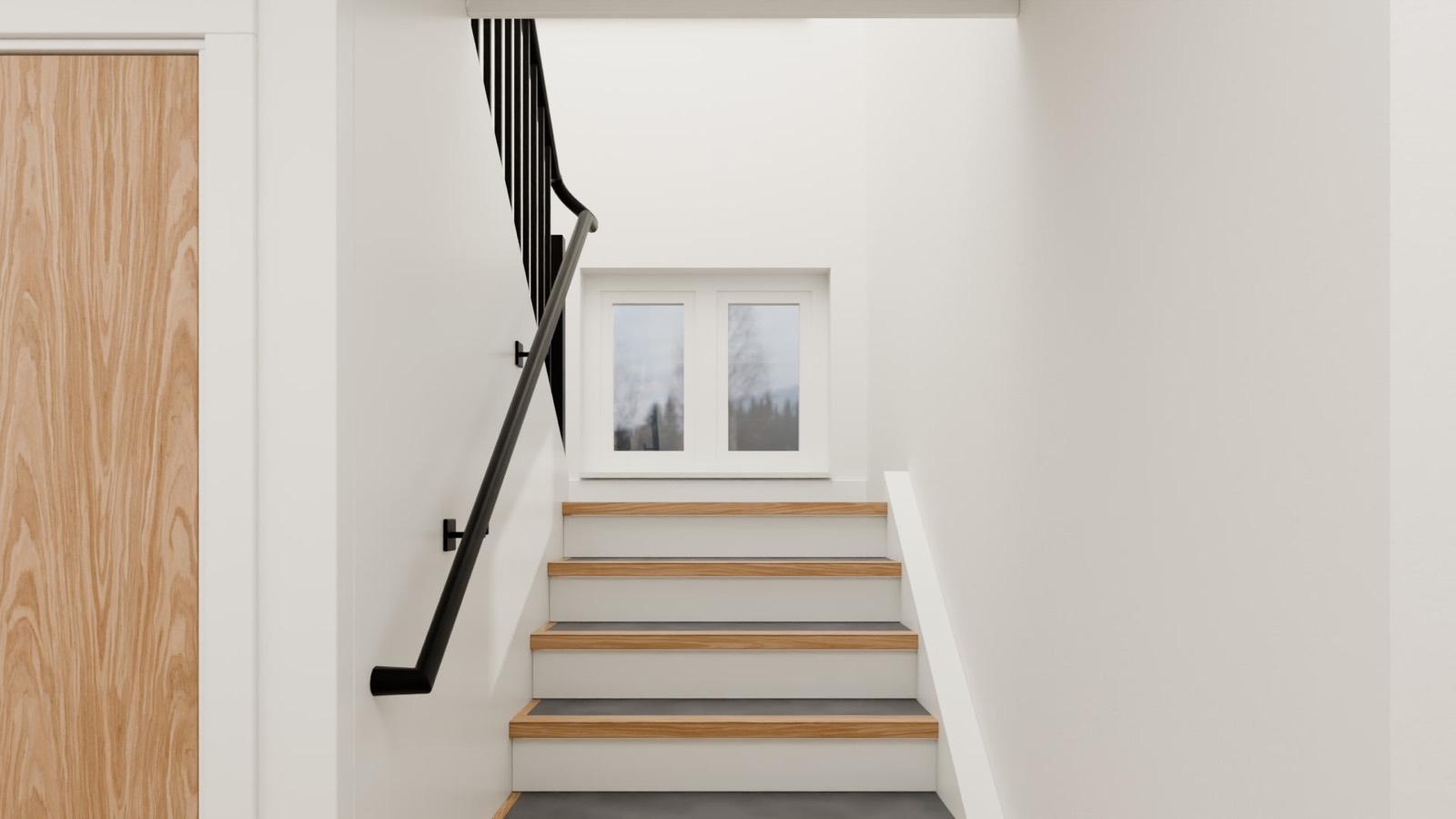
Yes, if the dimensions are right. As a second case I captured a staircase with a smartphone's LiDAR scanner. LiDAR is a measuring method using laser light that many smartphones have built in and that captures the geometry of a room. The scan served as the dimensional basis, and on top of it Blender produced a clean rebuild with three design variants, each in a daytime and an evening view. I also tried placing the new design directly into the scan. That result was not fit for presentation (as of 24 Oct 2026). The cover image of this article shows variant B of the rebuild.
The third case was a room renovation in an existing building in October 2026. Here too, the smartphone's LiDAR scan delivered the room dimensions. From them, Blender produced a 3D visualization on which ideas for walls, ceiling, skirting boards, windows and a new desk position with additional sockets can be tried out. The path from phone scan to a visualization to scale works. Design questions can be settled on the model before anyone drills a hole.
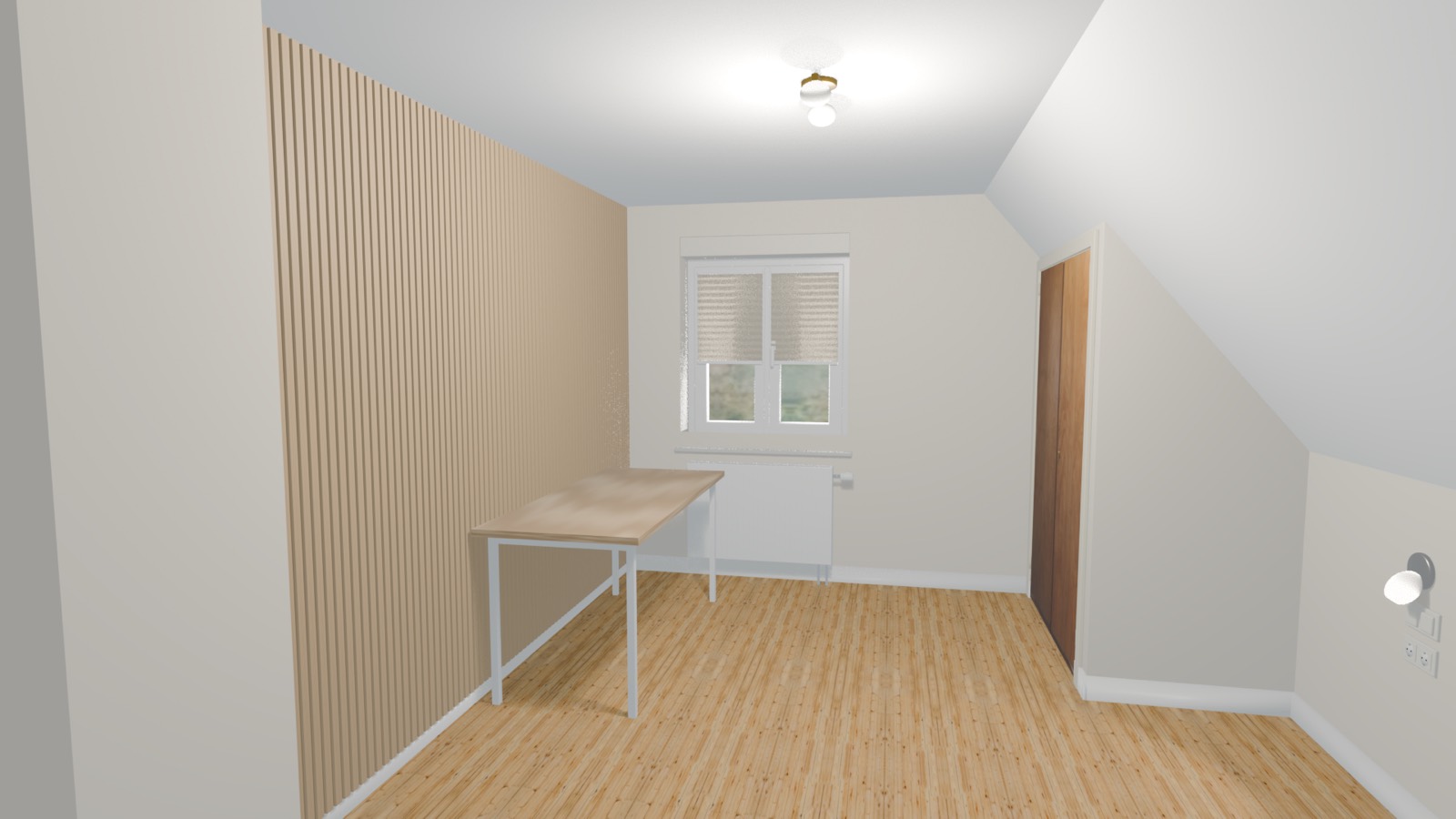
Room renovation, variant with wooden slats and pleated blinds, created in Blender from a LiDAR scan. As of October 2026.
Is this already a digital twin?
No. A digital twin is a virtual representation of a real facility that is connected to current data, such as sensor values or order data. The models from my test have no such connection. They remain 3D models for planning and presentation. Because the geometry is right and exists as code, they can still be the starting point for a later twin.
Does this also work with local AI?
Not reliably yet. On 26 Oct 2026 I connected a local language model with 12 billion parameters to Blender. It passed a reading test, meaning reading out an existing scene. Building a simple scene failed. Components lay apart from each other and objects floated in the room (own measurement, 26 Oct 2026).
Technically the path is open. Since version 0.3.17, LM Studio connects local models to tools via MCP and asks for confirmation before every tool call (InfoQ, 5 Jul 2025). For companies with confidential plans this is interesting, because floor plans and dimensions then stay in their own network. What a local model is and which hardware it needs is explained in the articles What is a local LLM? and Which hardware does a local LLM need?
A security question remains in any case. Blender Lab points out that its MCP server executes AI-generated code without any safeguards and recommends a virtual machine or a system without access to sensitive data (blender.org, accessed 10 Nov 2026). Anyone using this in a company should isolate the environment accordingly.
What can companies take away?
A lot of effort can be saved before the first prompt. A short specification with dimensions, data sheets and domain rules prevents most correction loops. Reusable building blocks such as people, vehicles and furniture belong in a checked library before the first scene is created. Approvals run faster on simple preview images than on finished renderings. Changes are best given collected in one round, because every short round pays for the base instructions again.
How local AI is assessed and introduced in mid-sized companies is described in the section AI in the mid-market. If you want to check whether your rooms, facilities or products can be visualized this way, we can talk about it in a first conversation.
Clarity before tools.
Frequently asked
Can an AI operate Blender on its own?
Yes, via the Model Context Protocol (MCP) an AI writes Python code that Blender executes. That way the AI builds walls, furniture, lighting and camera and checks the result on preview images. You have to give it domain rules and exact dimensions, otherwise many correction loops follow. In the test, individual components needed up to four attempts (own measurement, 24 Oct 2026).
How accurate are 3D models that an AI creates from a photo?
Good enough for presentations from a distance, not for work to scale. Image-to-3D tools add the sides that are not visible in the photo and estimate the proportions while doing so. In the test, one component of a vehicle deviated by around 17 centimetres from the data sheet, and hands and textures looked coarse up close (own measurement, 24 Oct 2026). Parts that must be to scale are better built from data sheets in code.
Can you turn a photo of a whole room into a 3D model?
A single photo does not produce a usable room model. Rooms need photogrammetry, meaning many overlapping photos from which a program calculates the geometry, a LiDAR scan, or a rebuild from photos and measured dimensions. In the test, a LiDAR scan with a smartphone proved itself as the basis for dimensions.
Is a smartphone LiDAR scan enough as the basis for planning a renovation?
It is enough for the visualization and for design decisions. In my test, the scan delivered the room dimensions from which Blender produced a model to scale for walls, ceiling, windows and a new workstation. Where millimetres matter, for example with built-in furniture, critical dimensions should also be measured by hand.
How safe is it to let an AI run code in Blender?
It is a risk you have to contain deliberately. Blender Lab points out that its MCP server executes AI-generated code without any safeguards and recommends a virtual machine or a system without access to sensitive data (blender.org, accessed 10 Nov 2026). With local models in LM Studio, every tool call can be confirmed beforehand.
Do I need specialist software or a 3D team for 3D visualization with AI?
No. Blender is free, and the AI handles the operation through code. What you need are exact dimensions, data sheets, clear domain specifications and someone who checks and approves the preview images. That is enough for presentations, room planning and variants, while photorealistic close-ups push the approach to its limits.
Local AI for business
Language models on your own hardware, GDPR-compliant and without vendor lock-in. Options, comparison with the cloud and the path to a pilot.
To the solution: local AI