What does RAG mean in an enterprise context?
Retrieval-Augmented Generation connects AI models to your own organisational knowledge. A clear explanation of what RAG is, how it works, and why it's one of the most relevant AI concepts for internal knowledge use.
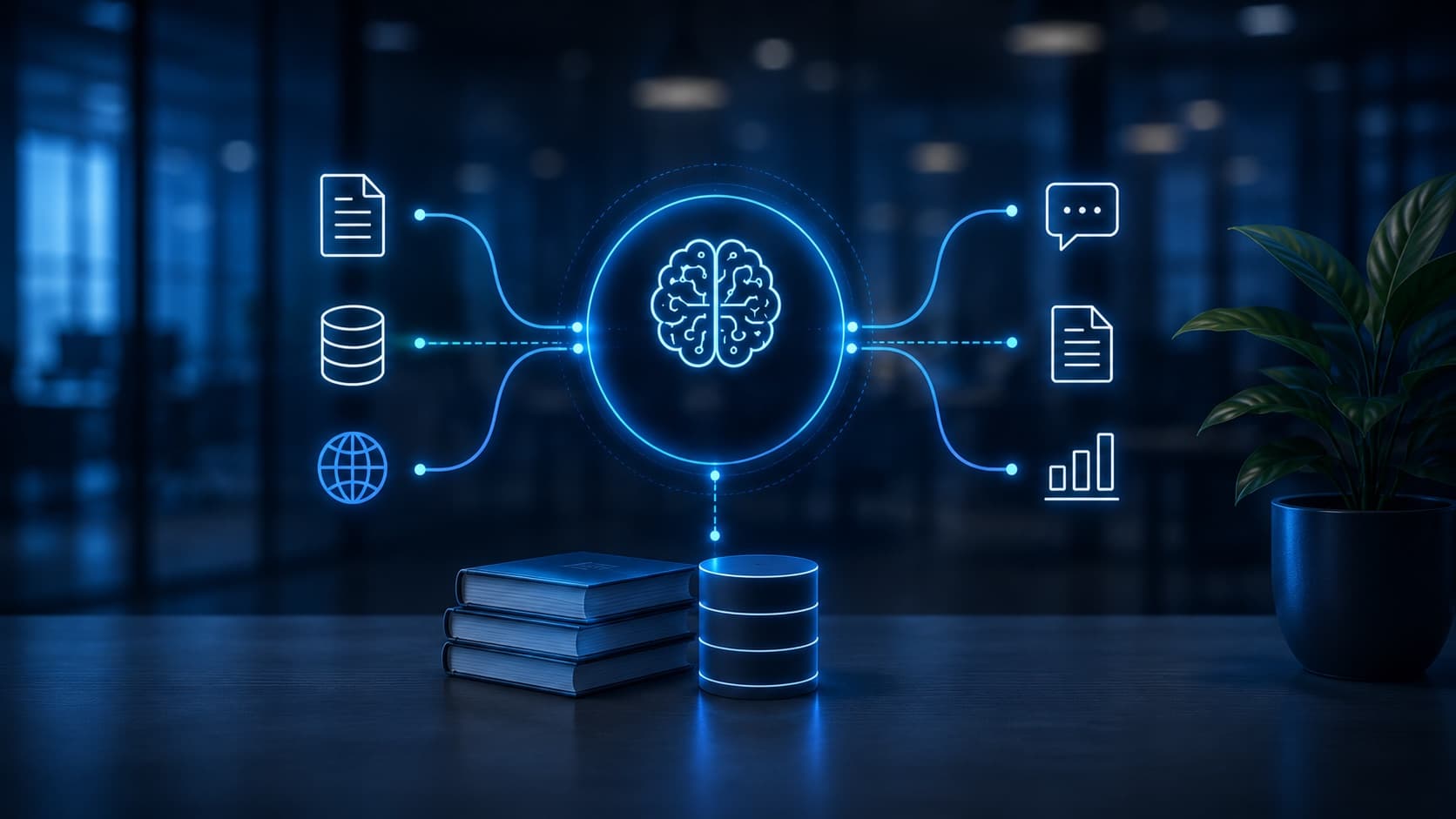
RAG stands for retrieval-augmented generation and is a method in which a language model receives matching passages from your own documents for each question and answers only from them, with source references. That is how an AI answers questions about manuals, contracts or process documents it does not know from training. RAG pays off as soon as staff regularly search such documents and answers need to be verifiable.
RAG stands for retrieval-augmented generation and describes a method in which a language model receives matching passages from your own documents before answering and answers only from them. An AI model knows a lot, but not what's in your internal documents. RAG closes that gap and connects the language understanding of a large language model with the knowledge of your organisation.
- RAG connects language models with your own organisational knowledge
- The system looks for matching passages in the document pool on each query, the model answers from them with source references
- Quality depends on data structure, relevance and goal
- RAG is a tool for specific use cases, not an end in itself
- A local RAG runs entirely under your own control
What is RAG?
RAG (retrieval-augmented generation) is a method in which a language model does not answer from its training alone. For each question, a retrieval mechanism first looks up matching sections in a defined document collection and hands them to the model as context. The model formulates the answer from those sections and names the source.
The difference from a standard LLM lies in the source of knowledge. The model answers from your documents and not only from what it saw in training.
How RAG works in practice
The principle can be explained in three steps:
- A query is made. An employee asks the internal assistant a question.
- Retrieval: relevant passages are found. The system searches the document pool and finds the most relevant sections for the query.
- Augmented generation: an answer is produced. The LLM receives the retrieved sections as context and generates a precise answer based on your own documents.
Typical use cases in organisations
Internal knowledge management
Employees ask questions to an internal assistant that accesses organisational handbooks, policies, process documents, onboarding materials or FAQs.
Document analysis
Contracts, reports, proposals or technical documentation can be quickly summarised, searched for specific clauses, or compared with other documents.
Customer-service support
Customer-service staff immediately get the relevant knowledge base for customer enquiries.
Technical documentation
Developers or technicians get contextual answers from handbooks, installation guides and technical specifications.
RAG is no silver bullet. Bad data produces bad answers. The quality of a RAG system depends directly on the quality, structure and currency of the documents it accesses.
How a local RAG is built, as of autumn 2026
A RAG system that runs entirely in your own network is usually just called RAG, in practice also local RAG or on-premise RAG. Technically it consists of five parts.
- Documents. PDF files, Word documents, wiki pages, tickets or emails. Beforehand it has to be clear which versions apply and what is outdated.
- Preparation. The documents are read, split into meaningful sections and tagged with details such as title, date and department. Scanned documents need text recognition first.
- Vector store. Each section is translated into a sequence of numbers that represents its meaning and stored in a vector database such as ChromaDB. That way the system also finds passages for a question that use different words.
- Language model. A local LLM, served via Ollama, formulates the answer from the retrieved sections. Open WebUI serves as the interface for chat and document questions.
- Access rights. A query only returns passages from documents the person asking would be allowed to read without AI. For that, the rights from the company directory are adopted and checked on every search.
Which open components have proven themselves for this is described in the article Which open-source AI is suitable for companies? How PDF collections become searchable in concrete terms is in the article Can AI search company PDFs?
How RAG differs from fine-tuning, skills and plugins
Fine-tuning changes the model itself by retraining it with your own examples. RAG leaves the model unchanged and hands it knowledge at runtime. For company knowledge, RAG is almost always the right start, because new documents are available immediately and every answer has a source. The article RAG or fine-tuning: what fits company knowledge? draws the comparison in detail.
A skill or plugin, by contrast, extends what an AI assistant can do, such as reading a calendar, running a calculation or following instructions for a specific task. RAG extends what the assistant knows. The two can be combined, a skill can query a RAG system, for example.
What good RAG projects share
- Define a clear use-case goal: which questions should the system answer?
- Structure, maintain and keep the document pool current
- Source relevance matters more than quantity
- Plan quality control of the answers
- Start with a small, clearly defined scope and extend step by step
- Consider access rights and data protection from the start
Why RAG and local AI go well together
RAG can run entirely locally. A local LLM combined with a local vector store gives a knowledge system fully under your own control.
What does this mean concretely for organisations?
RAG is one of the most direct paths to practical AI value in organisations. What it needs: a clear objective, a cleanly prepared knowledge base, and the willingness to learn iteratively.
RAG is one of the most underestimated entries into practical AI use. In combination with local LLMs, applications emerge that stay entirely under your own control.
Frequently asked
What does RAG mean in simple terms?
RAG means that an AI looks things up in your documents before answering. The abbreviation stands for retrieval-augmented generation. For a question, the system picks out the matching passages, hands them to the language model, and the model answers only from them and names the source. That is how an AI can answer questions about manuals, contracts or policies it does not know from training.
How does company knowledge get into a RAG system?
Company knowledge goes in as documents, meaning PDF files, Word documents, wiki pages, tickets or emails. These are read, split into sections and stored in a vector store that finds the matching passages for each question. Knowledge that only exists in people's heads has to be written down first. New or changed documents are reloaded regularly so that answers stay current.
Do I need cloud infrastructure for RAG?
No. RAG can run fully locally. With a local LLM and a local vector store, you get systems that don't send any data outside. For organisations in regulated industries, that is often the decisive advantage.
What is a RAG system called when it runs with a local AI?
It is still called RAG. In practice people say local RAG, on-premise RAG or private RAG when all parts run in your own network, meaning documents, vector store and language model. There is no separate technical term such as RAG container, even though the components are often delivered as containers. The architecture is the same as for RAG in the cloud, only the place of operation differs.
What is the difference between RAG and fine-tuning?
RAG hands the model knowledge at runtime and leaves the model itself unchanged. Fine-tuning retrains the model with your own examples and changes it permanently. For company knowledge, RAG is almost always the right start, because new documents are available immediately and every answer has a source. Fine-tuning pays off for style, format and fixed terminology. The article 'RAG or fine-tuning' draws the comparison in detail.
How does RAG differ from a skill or plugin?
RAG extends what an AI assistant knows, a skill or plugin extends what it can do. With RAG the assistant answers questions from your documents. With a skill or plugin it can also do something, such as read appointments, calculate or follow instructions for a specific task. The terms skill and plugin are used differently from one provider to another, and both can be combined with RAG.
How many documents does a RAG system need at minimum?
Even with few, well-structured documents you can get first results. More important than quantity is quality and relevance. A well-curated pool of 50 documents beats an unstructured pool of 5,000.
What are typical entry-level RAG projects for the mid-market?
An internal FAQ assistant for HR questions based on existing policies, a product-documentation assistant for sales, or a policy assistant for compliance questions.
Enterprise knowledge with AI
Private knowledge systems that answer questions about your documents with source references. Locally or in an EU environment.
To the solution: enterprise knowledge