Questions & answersOpen WebUI or ChatGPT: what fits a company?
The interface looks similar. Behind it are two different operating models.
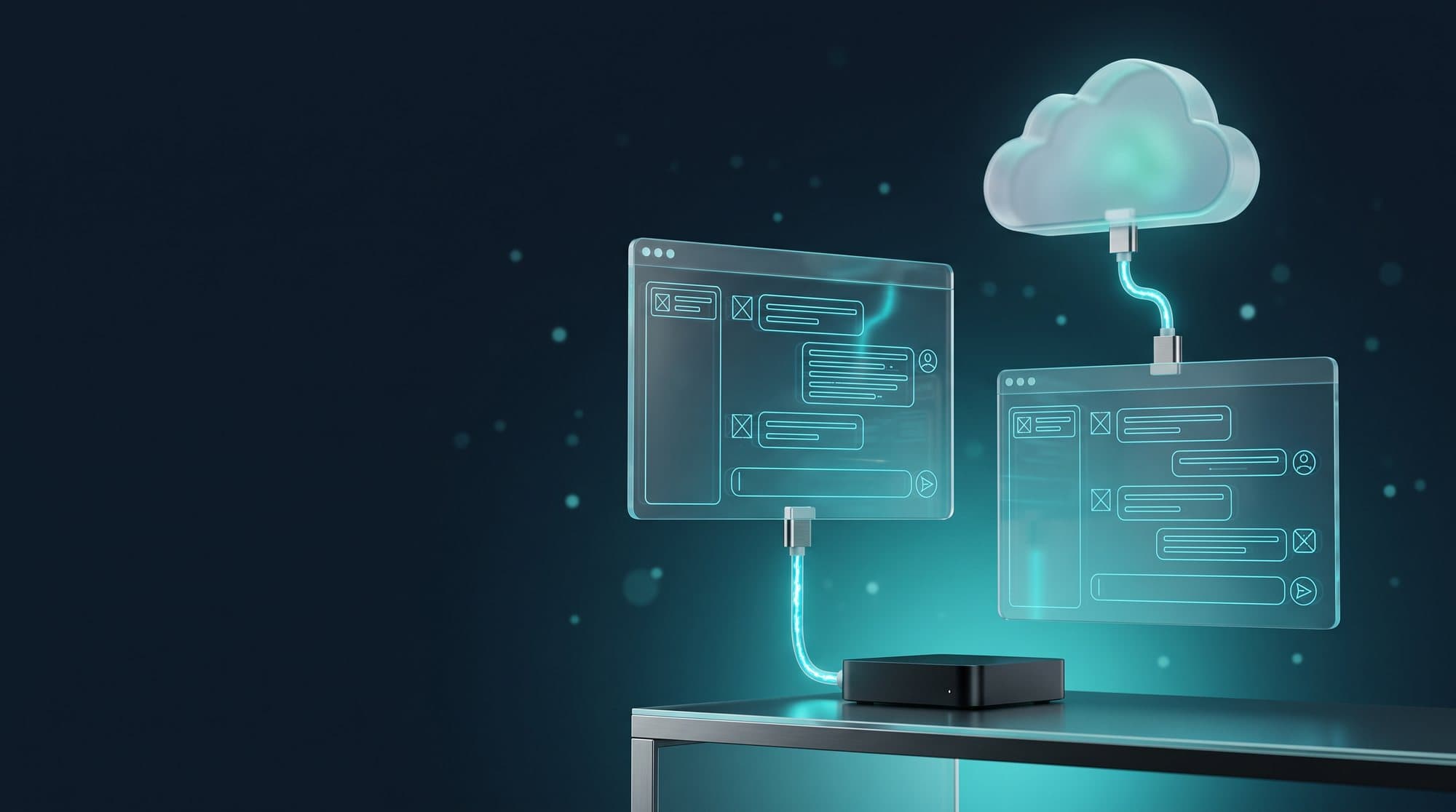
Open WebUI is an open-source interface that runs in your own network and connects any language model, locally via Ollama or through an API. ChatGPT is a cloud service with one provider's models. For companies with confidential data, many users or the wish for free model choice, Open WebUI is the fitting choice. For a few users with non-critical tasks, ChatGPT remains the faster route.
When does Open WebUI make sense?
When a company wants to offer AI to many employees without data leaving the building. When permissions per department or knowledge base are needed. When model choice should stay free, including European models. And when AI should be integrated into your own processes, because Open WebUI runs alongside n8n and other tools in the same network.
When does ChatGPT make sense?
For individual users or small teams with non-critical tasks who want to start right away. For tasks that need the very strongest models. And for companies without an IT team that could look after a server. With a business account and a processing agreement, ChatGPT is a defensible route for non-critical data.
Prerequisites for Open WebUI
- A server or virtual machine in your own network, plus a model server such as Ollama with suitable hardware.
- Integration with the user directory so that login and permissions work cleanly.
- A data classification that defines which documents may go into knowledge bases.
- Someone who applies updates. The project moves fast.
Options
Open WebUI bundles what companies need from an AI interface: chat with history and several models, knowledge bases with document questions and source references, roles and groups, directory login, templates for recurring tasks, optionally speech input and output and image generation. Through APIs, local and external models can be run side by side.
Benefits
- Runs in your own network, without data leakage.
- Free model choice and the option to switch models.
- Permissions and knowledge bases per department, not one account for everyone.
- No user licences.
Limits and risks
Open WebUI is software that has to be operated: updates, backups, access protection. The quality of the answers depends on the connected model and the hardware, not on the interface. And anyone who expects all the convenience features of a large provider will find individual gaps.
Example
A trading company had several ChatGPT accounts across departments, without overview and without rules. With Open WebUI in its own network, all employees got the same access, logged in via the directory. Confidential tasks ran through a local model, non-critical research through a connected cloud model. The departments received their own knowledge bases. The accounts were cancelled, usage became visible.
Frequently asked
What is Open WebUI?
An open-source web interface for language models: chat with history, user management, roles, knowledge bases with document questions, model selection. It runs on your own server and talks to Ollama or other model servers.
Can Open WebUI also use cloud models?
Yes, external models can be connected through APIs. That way non-critical tasks can go to a large cloud model and confidential ones to the local one, in the same interface, with the same permissions.
Is Open WebUI as convenient as ChatGPT?
Very similar in use. What is missing are some of the provider's extra features. What is added: permissions per knowledge base, login via the company directory, connection to your own workflows.
What does Open WebUI cost?
The software is free. Costs arise for hardware, setup and operations. For the enterprise edition with support there are commercial offerings from the project.
Conclusion
The interface is not the decision. The decision is where your data resides, who chooses the models and how many users work. For companies with confidential data and more than a handful of users, Open WebUI with a local model is the fitting route. ChatGPT remains the right tool for the quick, non-critical case.
Related questions: Can you run ChatGPT locally in a company?, Which open-source AI is suitable for companies?, What is a local LLM? And why is it relevant for organisations?
Local AI for business
Language models on your own hardware, GDPR-compliant and without vendor lock-in. Options, comparison with the cloud and the path to a pilot.
To the solution: local AI