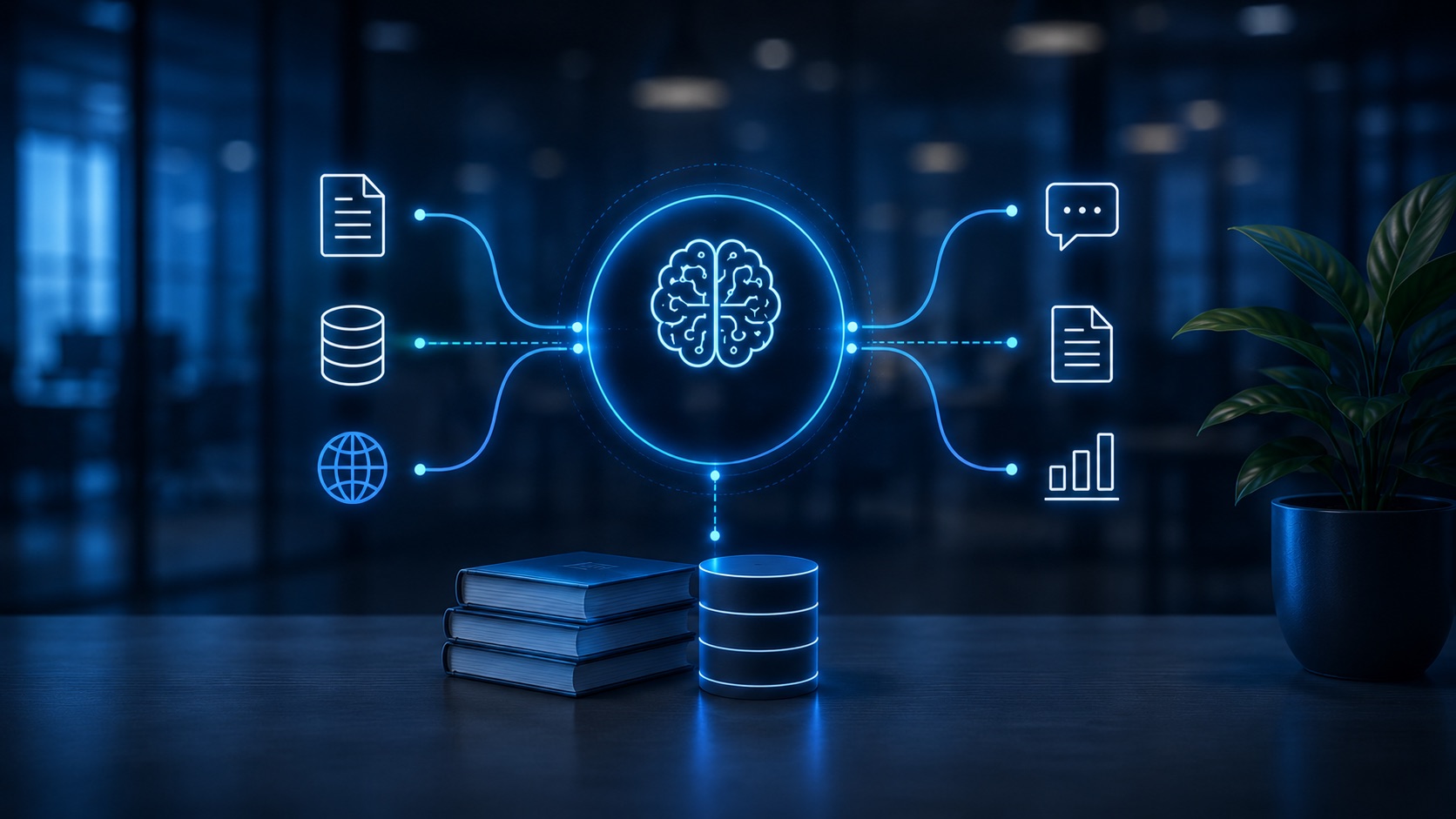
An AI model knows a lot, but not what's in your internal documents. RAG solves that problem: it connects the language understanding of a large language model with the specific knowledge of your organisation.
- RAG connects LLMs with your own organisational knowledge
- The model looks for relevant passages in the document pool on each query
- Quality depends on data structure, relevance and goal
- RAG isn't an end in itself, but a tool for specific use cases
- Local RAG systems can run entirely under your own control
What is RAG?
The name "Retrieval-Augmented Generation" describes the principle precisely: a large language model (LLM) is combined with a retrieval mechanism that, on every query, looks up relevant information from a defined document pool.
The decisive difference from a standard LLM: the model doesn't only answer from its training, but from your knowledge.
How RAG works in practice
The principle can be explained in three steps:
- A query is made: An employee asks the internal assistant a question.
- Retrieval: relevant passages are found. The system searches the document pool and finds the most relevant sections for the query.
- Augmented generation: an answer is produced. The LLM receives the retrieved sections as context and generates a precise answer based on your own documents.
Typical use cases in organisations
Internal knowledge management
Employees ask questions to an internal assistant that accesses organisational handbooks, policies, process documents, onboarding materials or FAQs.
Document analysis
Contracts, reports, proposals or technical documentation can be quickly summarised, searched for specific clauses, or compared with other documents.
Customer-service support
Customer-service staff immediately get the relevant knowledge base for customer enquiries.
Technical documentation
Developers or technicians get contextual answers from handbooks, installation guides and technical specifications.
RAG is no silver bullet. Bad data produces bad answers. The quality of a RAG system depends directly on the quality, structure and currency of the documents it accesses.
What good RAG projects share
- Define a clear use-case goal: which questions should the system answer?
- Structure, maintain and keep the document pool current
- Source relevance matters more than quantity
- Plan quality control of the answers
- Start with a small, clearly defined scope and extend step by step
- Consider access rights and data protection from the start
RAG and local AI: a strong combination
RAG can run entirely locally. That means: a local LLM combined with a local vector store gives a knowledge system fully under your own control.
What does this mean concretely for organisations?
RAG is one of the most direct paths to practical AI value in organisations. What it needs: a clear objective, a cleanly prepared knowledge base, and the willingness to learn iteratively.
RAG is one of the most underestimated entries into practical AI use. In combination with local LLMs, applications emerge that stay entirely under your own control.
Frequently asked questions
Do I need cloud infrastructure for RAG?
No. RAG can run fully locally.
How many documents does a RAG system need at minimum?
Even with few, well-structured documents you can get first results.
What are typical entry-level RAG projects for the mid-market?
An internal FAQ assistant for HR questions, a product-documentation assistant for sales, or a policy assistant for compliance.